


50 Jahre Stiftungsarbeit: „Wilhelm“ erscheint zur Jubiläumsausgabe
Die Wilhelm Sander-Stiftung bringt mit WILHELM ein eigenes Magazin heraus, das künftig einmal jährlich erscheint. Den Auftakt macht die Jubiläumsausgabe zum 50-jährigen Bestehen der Stiftung.

The entrepreneurial driving force behind science: 50 years of the Wilhelm Sander Foundation
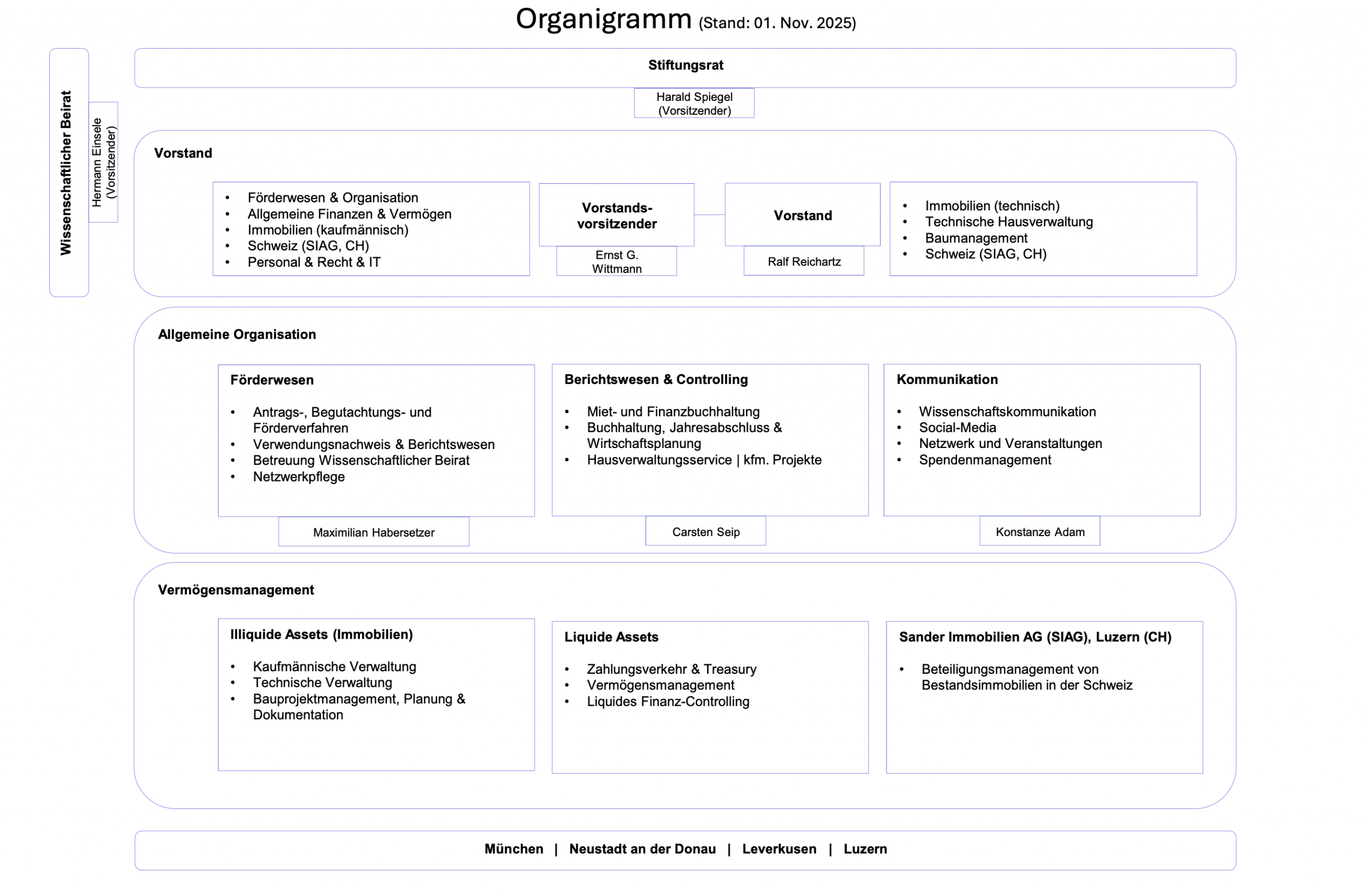
Which research projects are given a chance? And why? This is the question the Wilhelm Sander Foundation has been asking itself since its foundation 50 years ago. The independent foundation, headquartered in Neustadt an der Donau with offices in Munich and Leverkusen, supports cutting-edge medical research with a particular focus on cancer research in Germany and Switzerland. The foundation was established from the estate of the Franconian entrepreneur Wilhelm Sander. Since 1975, the foundation has provided around 350 million euros in funding for 2,700 research projects. On 19 June 2026, the foundation will celebrate its anniversary in the auditorium of the Deutsches Museum in Munich. Its sights are firmly set on the future of research funding.
Two signalling pathways work together to make glioblastoma cells more susceptible to the immune system
Glioblastomas are highly aggressive brain tumours and are resistant to both conventional and targeted therapeutic interventions. Immune evasion is pronounced in glioblastomas, which complicates immunotherapy for most patients. Interferon-γ is a messenger substance used by immune cells to inhibit and kill cancer cells. Researchers led by Claudio Giachino from the Department of Biomedicine at the University of Basel now have evidence that the activity of the Notch signalling pathway makes certain subtypes of glioblastoma more sensitive to interferon. The Wilhelm Sander Foundation supported the project with approximately €165,000.
Launch of a new partnership: The Bavarian Academy of Sciences and Humanities and the Wilhelm Sander Foundation are organising an international symposium
The Bavarian Academy of Sciences (BAdW) and the Wilhelm Sander Foundation are launching their collaboration with an international scientific symposium in March 2027 on the topics of immuno-oncology and ferroptosis. The event marks the start of enhanced cooperation in the field of science communication – with the aim of jointly strengthening the visibility and societal impact of medical research, particularly cancer research.
New prospects for bile duct cancer: PARP-1 as a therapeutic target in KRAS-mutated intrahepatic cholangiocarcinomas
Intrahepatic cholangiocarcinomas (iCCAs) are among the most aggressive forms of cancer worldwide. Despite advances in systemic therapy, treatment options remain limited, which is why new strategies are urgently needed. A study led by Prof. Dr Jens Marquardt at the UKSH in Lübeck has now shown that the activation of PARP-1 plays a key role in KRAS-mutated iCCAs – a mutation associated with a particularly poor prognosis. Targeted inhibition of PARP-1 significantly reduced tumour growth in preclinical models. These findings open up new avenues for personalised therapies. The Wilhelm Sander Foundation supported the project with €180,000.
A potential new strategy for overcoming resistance to immunotherapy in pancreatic cancer and other tumours
Cellular and immunotherapies are currently either ineffective or only partially effective in the treatment of pancreatic cancer. Researchers at LMU Munich had discovered that this is due, amongst other things, to a specific signalling molecule, prostaglandin, which is released by both cancer cells and their surrounding environment. With funding of 177,000 euros from the Wilhelm Sander Foundation, Sebastian Kobold’s research group has now developed a potential strategy for selectively switching off this signalling pathway. Using gene scissors, the scientists have now been able to block the effect of prostaglandins in cellular therapies, which could potentially make immunotherapies feasible for this disease as well.
Genetic mutation opens up new targets for treating neuroblastoma
Neuroblastoma, an aggressive form of childhood cancer, is often difficult to treat – particularly when it is associated with unfavourable genetic alterations. Led by Dr Jan Dörr, a research team has now investigated how the DDX1 gene influences the properties of tumour cells. The researchers were able to show that, in many aggressive neuroblastomas, DDX1 is amplified alongside the oncogene MYCN, alters cellular metabolism and creates a dependency on the mTOR signalling pathway. Furthermore, the gene influences how cancer cells respond to chemotherapy. The Wilhelm Sander Foundation funded the project with around 198,000 euros. The findings point to a potential new target for future therapies.
Infrared molecular fingerprinting: a new approach to early cancer detection
The Wilhelm Sander Foundation is providing funding of around one million euros for a pioneering research project at Ludwig Maximilian University of Munich (LMU) and the Max Planck Institute for Quantum Optics. The aim of the project, led by Prof. Dr Ferenc Krausz and Prof. Dr Mihaela Žigman, is to develop a new form of molecular cancer diagnostics and bring it into clinical use. As early diagnosis is the most important prerequisite for successful treatment in most forms of cancer, molecular blood analyses open up new possibilities in this regard: they reveal disease-related changes in individual organs within the context of the body as a whole.
Research that makes a difference: The Wilhelm Sander Foundation is providing €3.3 million in funding for 20 projects in the fight against cancer in the first quarter of 2026
Scientific progress through synergy: The 20 projects that the Wilhelm Sander Foundation accepted for funding at the start of 2026 cover a broad spectrum of modern cancer research. The projects take an integrative approach, ranging from the identification of new molecular targets – for example, in the cell membrane or the immune system – to the optimisation of clinical processes through precise monitoring of treatment. The aim is to gain a fundamental understanding of the complex mechanisms underlying tumour development and the emergence of resistance, and to translate this into therapeutic benefits.
Tumour-specific ‘alarm system’ improves the efficacy of CAR-T cell therapy
Researchers led by Dr Nadia El Khawanky, Dr Simon Heidegger and Dr Nardine Soliman from the Third Department of Internal Medicine at the Technical University of Munich Hospital (TUM Hospital) have, with funding of 146,000 euros from the Wilhelm Sander Foundation, uncovered key mechanisms by which tumour cells develop resistance to CAR-T cells. The scientists demonstrated that an innate cellular alarm system, which normally detects viral infections, plays a crucial role in determining how susceptible tumour cells are to attack by CAR-T cells. This opens up new approaches to making CAR-T cell therapies effective against solid tumours as well.