


Genetic mutation opens up new targets for treating neuroblastoma
Neuroblastoma, an aggressive form of childhood cancer, is often difficult to treat – particularly when it is associated with unfavourable genetic alterations. Led by Dr Jan Dörr, a research team has now investigated how the DDX1 gene influences the properties of tumour cells. The researchers were able to show that, in many aggressive neuroblastomas, DDX1 is amplified alongside the oncogene MYCN, alters cellular metabolism and creates a dependency on the mTOR signalling pathway. Furthermore, the gene influences how cancer cells respond to chemotherapy. The Wilhelm Sander Foundation funded the project with around 198,000 euros. The findings point to a potential new target for future therapies.

Property management in foundations: between tradition and professionalisation
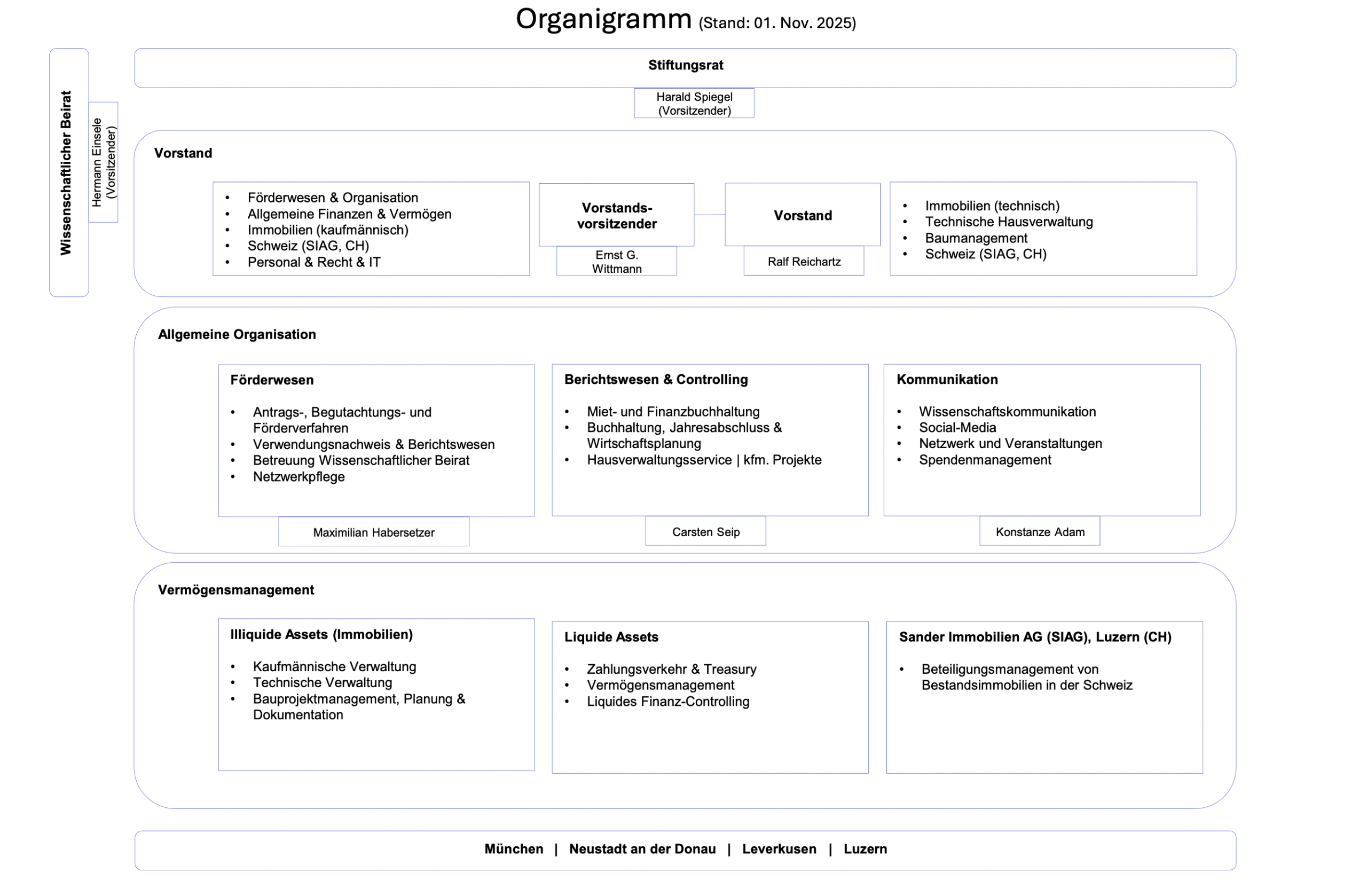
In many places, foundations’ property portfolios have grown organically over decades – and in some cases over centuries. They served as a secure investment, a means of securing long-term returns, or directly to fulfil the foundation’s purpose. In the past, property management could be limited to letting flats as they became vacant, carrying out ad hoc repairs and, in individual cases, modernisation, as well as simple management models (settling operating and heating costs). Decisions were made with sound judgement, but rarely with a strategic focus on returns, liquidity and risk against the backdrop of foundation-specific requirements.
By Ernst G. Wittmann
Infrared molecular fingerprinting: a new approach to early cancer detection
The Wilhelm Sander Foundation is providing funding of around one million euros for a pioneering research project at Ludwig Maximilian University of Munich (LMU) and the Max Planck Institute for Quantum Optics. The aim of the project, led by Prof. Dr Ferenc Krausz and Prof. Dr Mihaela Žigman, is to develop a new form of molecular cancer diagnostics and bring it into clinical use. As early diagnosis is the most important prerequisite for successful treatment in most forms of cancer, molecular blood analyses open up new possibilities in this regard: they reveal disease-related changes in individual organs within the context of the body as a whole.
A new impetus for cancer treatments: the Wilhelm Sander Foundation is funding research projects to the tune of 1.3 million euros
The Wilhelm Sander Foundation is once again providing significant impetus for cancer research: in the second quarter of 2025, it is supporting seven research projects with a total of 1.3 million euros. The funded projects focus on innovative approaches to overcoming treatment resistance and the development of personalised treatment strategies.

Research that makes a difference: The Wilhelm Sander Foundation is providing €3.3 million in funding for 20 projects in the fight against cancer in the first quarter of 2026
Scientific progress through synergy: The 20 projects that the Wilhelm Sander Foundation accepted for funding at the start of 2026 cover a broad spectrum of modern cancer research. The projects take an integrative approach, ranging from the identification of new molecular targets – for example, in the cell membrane or the immune system – to the optimisation of clinical processes through precise monitoring of treatment. The aim is to gain a fundamental understanding of the complex mechanisms underlying tumour development and the emergence of resistance, and to translate this into therapeutic benefits.
Tumour-specific ‘alarm system’ improves the efficacy of CAR-T cell therapy
Researchers led by Dr Nadia El Khawanky, Dr Simon Heidegger and Dr Nardine Soliman from the Third Department of Internal Medicine at the Technical University of Munich Hospital (TUM Hospital) have, with funding of 146,000 euros from the Wilhelm Sander Foundation, uncovered key mechanisms by which tumour cells develop resistance to CAR-T cells. The scientists demonstrated that an innate cellular alarm system, which normally detects viral infections, plays a crucial role in determining how susceptible tumour cells are to attack by CAR-T cells. This opens up new approaches to making CAR-T cell therapies effective against solid tumours as well.
Understanding the mechanisms of metastasis
Metastases – that is, secondary tumours formed by cancer cells – pose a major problem in many forms of cancer. As offshoots of the primary tumour, they can grow in distant organs and are often difficult to detect. A research team led by Dr Tobias Reiff at the Institute of Genetics at Heinrich Heine University Düsseldorf (HHU) has now discovered molecular mechanisms that enable cancer cells to establish themselves in other tissues. The Wilhelm Sander Foundation funded the project with approximately 183,000 euros. The findings have now been published in the journal *Nature Communications*.
From the laboratory to the clinic: the Wilhelm Sander Foundation is providing €1.9 million in funding for 12 research projects in the fourth quarter of 2025
Basic research meets clinical application: The twelve projects funded by the Wilhelm Sander Foundation in the fourth quarter of 2025 span the spectrum from molecular mechanisms to the treatment room – from the question of how a basement membrane influences metastasis, to AI-supported tools designed to assist doctors in making treatment decisions.