
Back when the time clock Still Set the pace
Two long-serving members of the foundation look back
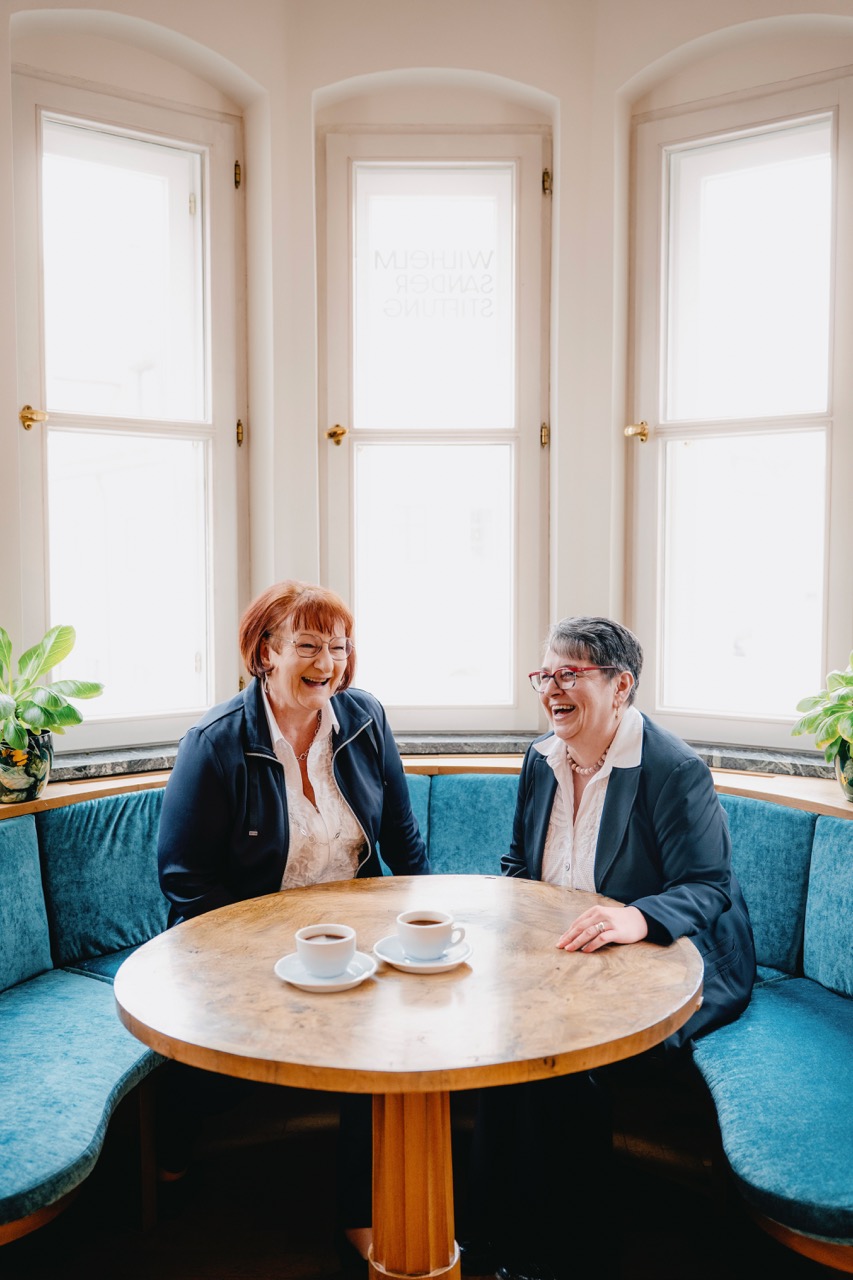
AN INTERVIEW WITH Roswitha Engelmann & Thea Treffer

When the time clock Still Set the pace
AN INTERVIEW WITH Roswitha Engelmann & Thea Treffer
Two long-standing members of the foundation look back


The time clock is no longer in use. Even the gong that once signalled the coffee break at 9.15 am has fallen silent at the Wilhelm Sander Foundation. Yet the memories are still very much alive, at least for Roswitha Engelmann and Thea Treffer. For many decades, these two women helped shape the foundation.
Between stock market prices and typewriters
In 1971, 15-year-old Roswitha Engelmann entered the building in Neustadt an der Donau for the first time. She only saw Wilhelm Sander himself a few times. “But I did notice that he sometimes stayed in bed in the mornings,” she recalls with a smile. Every day at 2 pm, someone had to go up to his room to pass on the stock market prices from the radio.
Roswitha Engelmann began her apprenticeship in rent accounting, whilst Thea Treffer started in financial accounting in 1975. Over the following decades, both helped shape the foundation in their own way. The young apprentices grew into experienced professionals who became reliable pillars of the organisation.
The office of the 1970s is a different world. Typewriters, index cards and carbon copies define everyday working life. There are ashtrays in every room; the air is thick with smoke. There is no kitchen. A coffee break means fetching water from outside, making coffee with the kettle and then washing the cups in a washing-up bowl. The desks are made of heavy wood, their surfaces so worn from years of writing that sheets of plastic have to be laid over them.
The path to the digital age
Their work, too, speaks of a different era. Roswitha Engelmann and Thea Treffer have experienced the digital transformation from the very beginning. They started out with index cards and carbon paper, recording every transaction by hand. Each tenant had their own index cards – later punch cards – which were processed externally in large machines. The results came back as long lists and had to be meticulously checked. “You simply can’t imagine that today,” says Thea Treffer.
In 1975, the first major technological shift began: For the first time, rents were collected by direct debit – a sensation at the time. The first external Nixdorf computer followed in 1976, and the first computer screens were introduced in 1979/80. They not only witnessed every technical innovation but also helped shape it as part of their day-to-day work.
Pranks and shenanigans
Where precision and structure ruled everyday office life, a bit of light-hearted fun was occasionally needed. The spirit of Carnival swept through the foundation every year. Once, a stink bomb even ended up in the office – of all places, in the department heads’ connecting room. “They were all looking for it, and I said: ‘No, no, it wasn’t me,’” admits Roswitha Engelmann with a mischievous smile.
Fool’s Thursday was the highlight of the season. Roswitha Engelmann recalls carnival nights when there was plenty of celebrating. The next morning, her colleagues would try to get through the working day as inconspicuously as possible and keep their superiors at a distance. “We were young,” she says with a smile, “and we weren’t going to miss out on the fun.” The pranks are a tradition: during a party, a board member’s tie is cut off without further ado, and colleagues are visited in hospital wearing masks. They get particularly creative when it comes to a head of department who stubbornly refuses to embrace technological innovations. They convinced him that you couldn’t work on the computer whilst the printer was running. “He actually believed that,” says Thea Treffer, still laughing about it today.
These little pranks, they say, strengthened team spirit and provided a welcome distraction from the meticulous office work. Never malicious, always with a twinkle in their eye.
More than just a job
What has kept the two of them at the foundation for decades is more than just their jobs. “It was a great give and take,” says Roswitha Engelmann. After the birth of her children, she worked part-time and remained loyal to the foundation. Employment contracts? None to speak of for decades. Much of it is based on trust.
The staff outings are legendary; the Christmas parties are a tradition. To this day, Roswitha Engelmann and Thea Treffer meet up to talk about the old days and how the foundation has changed.
Some 40 years lie between the typewriter and the computer, between carbon paper and email. What remains are the stories of two women who have not only accompanied the foundation, but have also helped to build, shape and sustain it.